
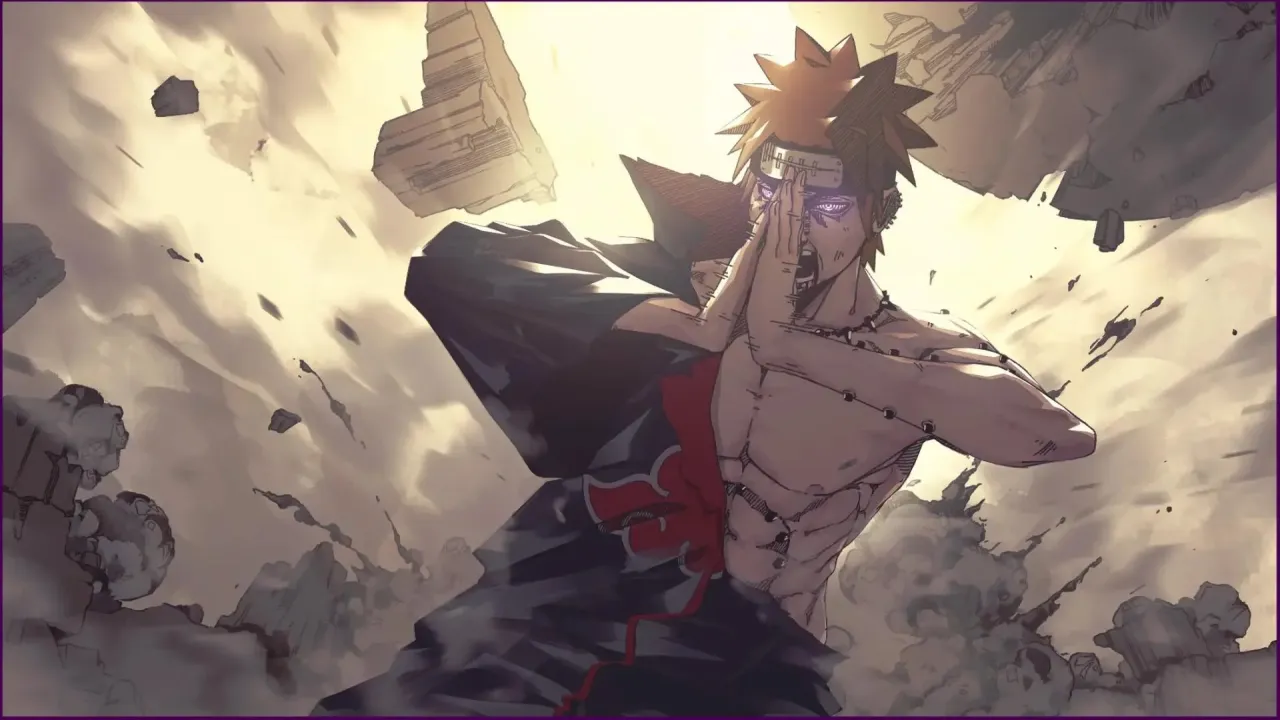
Few characters in Naruto have left as profound an impact as Pain. As the merciless leader of the Akatsuki and self-proclaimed god, he embodied the dark reality of the shinobi world—a cycle of hatred born from endless conflict. But beneath the piercings and the Rinnegan lay Nagato, a once-idealistic child whose own suffering twisted his noble dream of peace into a terrifying vision of order through fear. This is the story of how a young Uzumaki came to wield the legendary dojutsu, the powers it granted him, and the truths and theories that surround his legacy.
The Boy Who Would Become a God
Nagato was born in Amegakure, a village ravaged by the wars of the Great Nations. His early life was defined by tragedy: during the Second Shinobi World War, Konoha shinobi broke into his home, mistaking his parents for enemy combatants. In the chaos, Nagato's parents were killed, and the emotional shock awakened a dormant power within him—the Rinnegan. In a blind rage, the young boy struck down the intruders, his eyes manifesting the same revered violet rings once held by the Sage of Six Paths himself.
Orphaned and alone, Nagato wandered until he met Yahiko and Konan, fellow war orphans who shared his desire for peace. The three were taken in by Jiraiya, the legendary Sannin, who taught them ninjutsu and believed Nagato might be the Child of Prophecy destined to save or destroy the world. For a time, hope blossomed. But after Jiraiya left, their fledgling Akatsuki movement attracted dangerous attention. Hanzo of the Salamander, colluding with Danzo Shimura, ambushed them, forcing Nagato to witness Yahiko's suicide. That moment shattered Nagato’s idealism, giving birth to the grim persona of Pain and a ruthless philosophy.
The Rinnegan: A Dojutsu Born from Tragedy
The Rinnegan is the most exalted of the Three Great Dojutsu, said to appear only in times of great turmoil. However, Nagato’s eyes were not a spontaneous gift. As revealed late in Shippuden, the Rinnegan originally belonged to Madara Uchiha. In his old age, Madara awakened it by combining Uchiha and Senju powers—the Indra and Asura chakra within him. Knowing he would not live to complete his Moon Eye Plan, he transplanted his Rinnegan into a young Nagato, a descendant of the Uzumaki clan, whose powerful life force and enormous chakra reserves could sustain the eyes. Nagato never knew this; he believed the Rinnegan was his own, a sign of his destiny.
The Uzumaki heritage was key. As distant relatives of the Senju, they possessed vitality and the ability to accommodate the Rinnegan's immense strain. This genetic compatibility makes Nagato's case unique, but it also raises questions: could another Uzumaki have awakened the Rinnegan naturally under the right conditions? While never confirmed, some fans theorize that Nagato’s intense emotional triggers might have accelerated the awakening, even though Madara's intervention was the true catalyst.
The Six Paths of Pain: Techniques of a False God
Nagato’s crippled body prevented him from fighting directly, so he channeled his chakra through black receivers into six corpses, creating the Six Paths of Pain. Each body possessed one specialized ability, linked by shared vision and under Nagato’s remote control:
- Deva Path: The most formidable, wielding gravitational powers. It could attract (Bansho Ten’in) or repel (Shinra Tensei) all matter, and its ultimate technique, Chibaku Tensei, could trap targets inside a colossal earthen satellite.
- Asura Path: A mechanized weapon arsenal hidden within the body, allowing missiles, lasers, and extra limbs—a perversion of flesh into living artillery.
- Human Path: Capable of ripping out a person’s soul to read their mind or kill them instantly.
- Animal Path: Summoned a variety of giant creatures, each with its own Rinnegan and unique attacks, ranging from a multi-headed dog to a chameleon.
- Preta Path: Absorbed all forms of chakra-based attacks, nullifying even sage-enhanced jutsu.
- Naraka Path: Invoked the King of Hell for interrogation and restoration, useful for repairing damaged Paths.
Beyond these six, Nagato retained access to the Outer Path, which allowed him to summon the Demonic Statue of the Outer Path (Gedo Mazo) and perform the Rinne Rebirth, a forbidden technique that could resurrect the dead at the cost of his own life. This immense versatility made Pain nearly unstoppable, single-handedly destroying Konoha in a display of divine wrath.
Nagato's Ideology: Pain, Peace, and the Cycle of Hatred
Pain’s philosophy was forged in trauma. He believed that true peace could never emerge from talk or kindness while humanity remained incapable of mutual understanding. Only by inflicting pain on a massive scale could people truly comprehend each other’s suffering, and only through the threat of a weapon so terrible—the Tailed Beasts united as a superpower—would nations be forced into a stable, fearful coexistence. His famous words to Naruto captured this bleak worldview: “We are just ordinary people driven to revenge in the name of justice. But if revenge is called justice, then that justice breeds yet more revenge… and becomes a chain of hatred.”
Naruto’s inability to refute Pain’s logic initially underscored the story’s central theme: the shinobi system itself perpetuates endless cycles of violence. Pain was a mirror of what Naruto could become if he succumbed to hate—a tragic caution that ultimately led Naruto to seek a different answer.
Theories and Legacy: The Truth Behind the Eyes
Even after Nagato’s redemption and death, his legacy lingers. The revelation that his Rinnegan was a transplant opens up intriguing fan debates. Could Nagato, as an Uzumaki, have awakened the Rinnegan naturally if given enough time and trauma? The dojutsu’s connection to Hagoromo Ōtsutsuki and the fusion of Indra and Asura’s chakra suggests a purely genetic path might be possible for an Uzumaki-Senju descendant, but no other Uzumaki in the series demonstrates this. Another theory posits that the Rinnegan might manifest differently depending on the host, explaining why Nagato’s usage focused on the Six Paths while Madara and Sasuke employed more space-time and unique abilities.
In the end, Nagato’s story is one of profound tragedy and ultimate hope. Manipulated by forces beyond his knowing, he walked a dark path, yet his final act was one of selfless restoration—resurrecting the people of Konoha with Rinne Rebirth. He entrusted his dream of peace to Naruto, proving that even a false god can choose a redemptive ending. His journey remains one of the most emotionally charged arcs in anime, reminding us that the line between savior and destroyer is often drawn by circumstances beyond one’s control.