
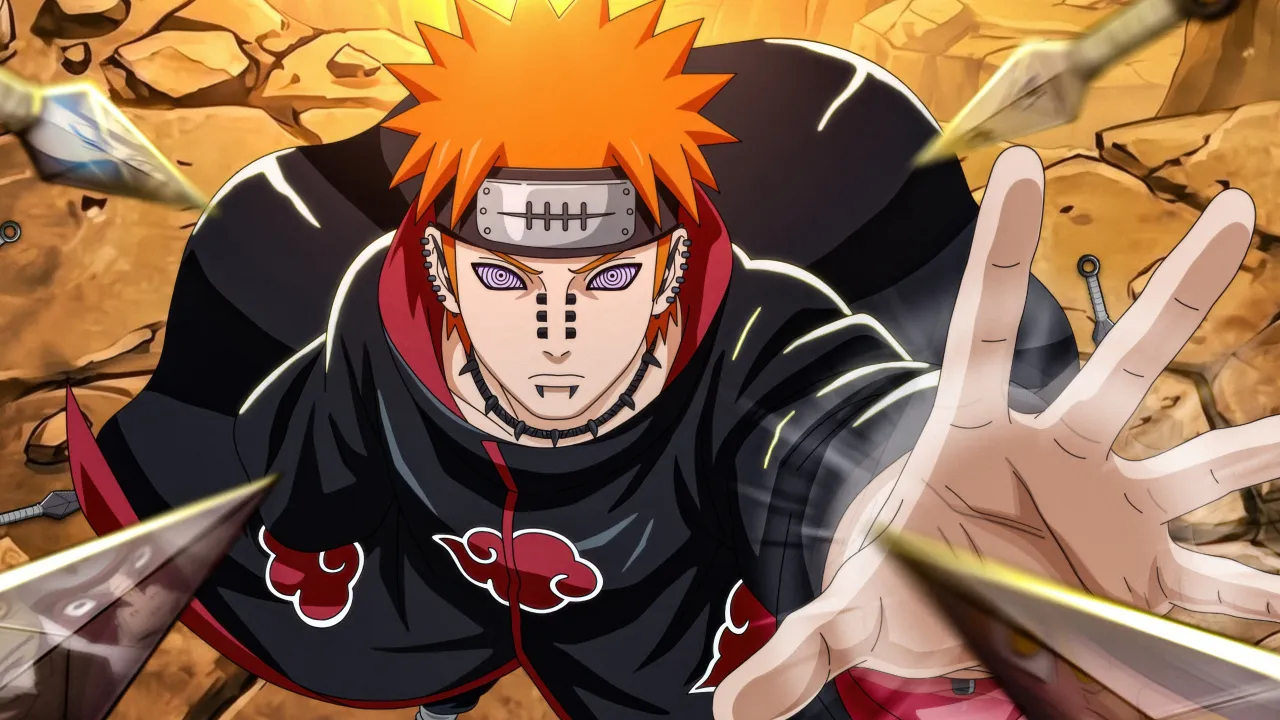
In the sprawling tapestry of Masashi Kishimoto’s Naruto, few characters embody tragedy and ideological depth like Nagato Uzumaki. Introduced as the enigmatic leader of the Akatsuki and the feared “Pain,” Nagato’s story is a spiral of suffering, misguided salvation, and eventual redemption. His arc challenges the very foundations of the shinobi world, forcing both the protagonist and the audience to question the nature of peace, pain, and human understanding.
The Orphaned Uzumaki and the Gift of the Rinnegan
Nagato was born into the war-torn Village Hidden in the Rain (Amegakure), a nation caught in the crossfire of the great ninja wars. As a descendant of the Uzumaki clan, he inherited a powerful life force and immense chakra reserves. However, his childhood was defined by loss: his parents were killed by Konoha shinobi during a home invasion, an event that awakened his fabled dōjutsu—the Rinnegan. Unbeknownst to him, it was actually Madara Uchiha who had implanted the eyes into him, setting the stage for a far-reaching plan.
The Rinnegan, the most exalted of the Three Great Dōjutsu, granted Nagato abilities that blurred the line between god and mortal. Orphaned and alone, he wandered until he met two fellow war orphans: Yahiko and Konan. Together, they formed a tight-knit group, dreaming of a world without bloodshed. Their resolve was later fortified by the legendary Sannin, Jiraiya, who trained them in ninjutsu for three years. Jiraiya saw in Nagato a child of prophecy, someone who could bring either great destruction or world-changing peace.
The Rise of the Akatsuki and Yahiko’s Sacrifice
Inspired by Jiraiya’s teachings, Nagato, Yahiko, and Konan founded the Akatsuki, an organization originally dedicated to ending conflict through non-violent means. Their ideals quickly attracted followers, but also the attention of Amegakure’s tyrannical leader, Hanzō of the Salamander. Conspiring with Danzō Shimura of Konoha, Hanzō set a trap: he would kill Konan unless Nagato murdered Yahiko. Faced with an impossible choice, Yahiko threw himself onto Nagato’s kunai, dying with the words: “You are the savior of this world.”
This moment shattered Nagato. The death of his best friend at the hands of a corrupt system transformed his idealism into a ruthless philosophy of control. Taking Yahiko’s body as the Deva Path, he reshaped the Akatsuki into a mercenary force that would ultimately seek to capture all tailed beasts. Nagato no longer believed in mutual understanding; he sought to impose peace through ultimate power, becoming the entity known as Pain.
The Six Paths of Pain and the Cycle of Hatred
Nagato’s crippled body was sustained by chakra receivers that allowed him to remotely control six reanimated corpses, each wielding one aspect of the Rinnegan’s power. This “Six Paths of Pain” sextet was his instrument of judgment, doling out “pain” to teach the world the folly of war. His assault on Konoha remains one of the most devastating arcs in Naruto Shippuden, where he demonstrated the terrifying scale of his abilities, including the catastrophic Shinra Tensei that flattened the entire village.
Pain’s ideology was rooted in the cycle of hatred: as long as humanity existed, so would conflict. His solution was to gather the tailed beasts and create a weapon so massive that it would force nations into submission, a momentary peace bought by fear. This was a direct confrontation of Naruto Uzumaki’s belief in trust and cooperation. Their battle was not just physical but philosophical—a clash of two disciples of Jiraiya with opposing answers to the same question.
Redemption and the Rinne Rebirth
Naruto’s resolve and his ability to forgive—even after Pain killed his mentors and friends—reached Nagato in a way no force could. In their final conversation, Naruto cited the words from Jiraiya’s book: “Wherever someone thinks of you, that’s where home is.” It resonated with Nagato, reminding him of his original dream. Choosing to believe in Naruto’s path, he performed the Rinne Rebirth technique, sacrificing his own life to restore all the souls he had taken in Konoha.
Nagato’s death was an act of atonement, not a defeat. He entrusted the future to Naruto, thus breaking his own cycle of tragedy. In a way, he fulfilled Jiraiya’s prophecy: a child who would bring revolution to the world, albeit through a winding road of pain and redemption.
Legacy of the Rain Village Visionary
Nagato’s impact extended beyond his life. The Akatsuki he built became the catalyst for the Fourth Great Ninja War, and his actions directly shaped Naruto’s evolution as a leader. The Village Hidden in the Rain, which Nagato had ruled with an iron fist, remained a testament to the failures of the shinobi system. Even after his death, his memories and ideals influenced the final resolution of the series, reminding everyone that the path to peace is paved with empathy, not power.
In the annals of anime history, Nagato Uzumaki stands as a cautionary tale and a mirror to the protagonist. His journey from a hopeful child to a self-proclaimed god, and back to a believer in humanity, encapsulates the core themes of Naruto. He remains one of the most complex villains—or perhaps antiheroes—ever written, whose questions still resonate with fans long after the story ended.