
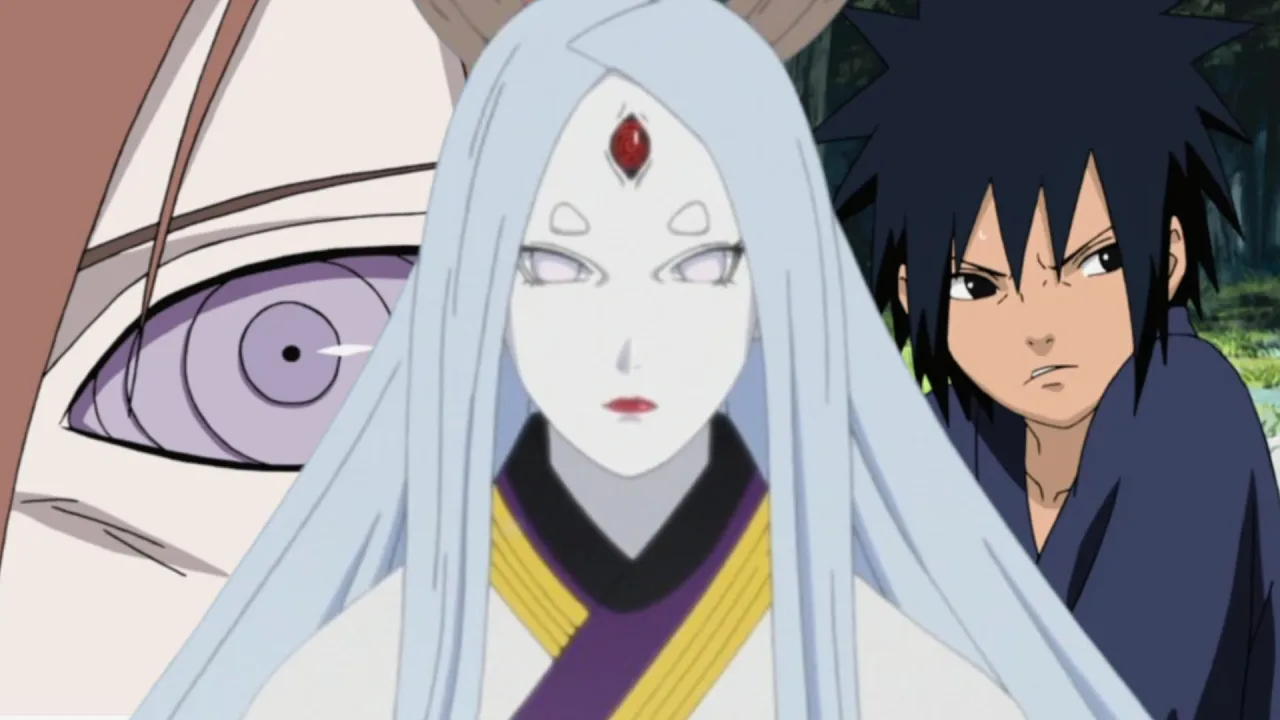
The world of Naruto is built on an intricate foundation of clan legacies, kekkei genkai, and ancient rivalries. But how did it all begin? The origin stories of the Uzumaki, Senju, Uchiha, and Hyuga clans are not just tales of war and treaties—they trace back to a single, otherworldly event: the arrival of Kaguya Ōtsutsuki. To truly understand these clans, we must journey to a time before shinobi even existed, when chakra was unknown and the Earth was primitive. This is the story of a goddess, a forbidden fruit, and the birth of the ninja era.
The Arrival of the Rabbit Goddess
Millennia before the Hidden Villages were founded, a celestial being descended from the stars. Kaguya Ōtsutsuki came to Earth from a distant world, part of the Ōtsutsuki clan whose members travel the cosmos harvesting chakra from planetary life forces. Her purpose was simple: to oversee the cultivation of the Divine Tree and collect its ultimate fruit for her clan. She landed in a land that would one day be known as the Land of That, a region untouched by modern civilization. At this point, Earth was a chaotic place, dominated by constant warfare among primitive human tribes. There was no concept of chakra—humans fought with crude weapons and raw strength alone.
The Divine Tree and the Birth of Chakra
The Divine Tree (Shinju) was a colossal, sentient organism that had already taken root on Earth. It was revered as a sacred entity, its towering branches reaching into the heavens. For centuries, it quietly absorbed the planet's natural energy, growing a single, radiant fruit of immense power. The tree was forbidden to humans, and its fruit was meant only for the Ōtsutsuki. But Kaguya's role changed when she witnessed the violence and oppression of the earthly conflicts. According to legend, she sought to bring peace to the world—though her motives may have been more complex. In a pivotal moment, she partook of the Divine Tree's fruit herself, gaining godlike power and becoming the first being to wield chakra on Earth. This act is the true genesis of the ninja world: chakra, the very essence of all future jutsu, was now present in a single, all-powerful being.
Kaguya's Transformation and the Ten-Tails
With the fruit's power, Kaguya single-handedly ended the wars and united the world under her rule. She was revered as the Rabbit Goddess, and for a time, humanity knew peace. But chakra is a corrosive force when concentrated in one vessel. Kaguya grew paranoid and possessive, merging with the Divine Tree itself to become the Ten-Tails (Jūbi), a monstrous entity capable of unleashing catastrophic destruction. She used a technique—the Infinite Tsukuyomi—to trap humanity in an eternal dream, absorbing their chakra to create an army of White Zetsu. This was her descent into madness, driven by a fear that her Ōtsutsuki kin would come to reclaim the stolen fruit. The stage was set for rebellion.
The Birth of Hagoromo and Hamura
Kaguya's most significant legacy came not through conquest, but through motherhood. She gave birth to twin sons: Hagoromo and Hamura Ōtsutsuki. Born with chakra inherited directly from their mother, they were the first true hybrids of Ōtsutsuki and Earth. Hagoromo, the elder, possessed immense wisdom and a deep connection to ninshū (the precursor to ninjutsu). Hamura, the younger, inherited a powerful dōjutsu—the Byakugan. Both would eventually challenge their mother's tyranny. In an epic battle, the brothers sealed the Ten-Tails within Hagoromo, making him the first jinchūriki and effectively creating the moon to imprison Kaguya's physical form. Hagoromo then became known as the Sage of Six Paths, a philosopher and teacher who spread the concept of chakra across the world, hoping to use it as a unifying force.
The Sage of Six Paths and His Legacy
Hagoromo's greatest contribution was the creation of the tailed beasts. Using his Creation of All Things Technique, he divided the Ten-Tails' chakra into nine sentient entities, thus preventing its overwhelming power from ever being abused again. He also had two sons of his own—Indra and Asura—who would become the founders of the most legendary clans. Indra, the elder, inherited his father's powerful eyes and believed that strength and destiny were the keys to peace. Asura, the younger, inherited his father's body and the ability to bond with others, believing cooperation was the true path. Their ideological clash would echo through generations.
The Origins of the Senju and Uchiha Clans
Indra's descendants became the Uchiha clan, inheriting the Sharingan and an affinity for fire and strength. Asura's descendants formed the Senju clan, known for their vast life force, chakra reserves, and mastery of ninshū. The two clans warred for centuries, with the Senju eventually allying with the Uzumaki—a distant branch of the same bloodline—to combat the Uchiha. This feud culminated in the founding of the Hidden Leaf Village, but the deep-seated tensions never fully dissolved. The Uchiha's Curse of Hatred and the Senju's Will of Fire are direct reflections of Indra and Asura's opposing philosophies.
The Hyuga: Descendants of Hamura
While Hagoromo's line split into Senju and Uchiha, his brother Hamura took a different path. Hamura led a branch of Ōtsutsuki descendants to the moon to guard the Gedo Statue, but some of his progeny remained on Earth. These would become the Hyuga clan, inheriting the Byakugan—an all-seeing eye that can perceive chakra networks and has near-360-degree vision. The Hyuga developed the Gentle Fist style, targeting the chakra pathway system directly. They prized the purity of their bloodline and established a rigid caste system to preserve their dōjutsu, a practice that would haunt them for generations.
The Uzumaki: The Forgotten Branch
Interestingly, the Uzumaki clan descended from Asura, just like the Senju. They were distant relatives, known for their incredible vitality, longevity, and expertise in fūinjutsu (sealing techniques). Their vivid red hair became a trademark, and their life force allowed them to survive events that would kill ordinary shinobi—Kushina Uzumaki famously survived the extraction of the Nine-Tails. The Uzumaki were so skilled in sealing that they were feared, leading to their village's destruction. While many of their techniques were scattered, their bloodline endured through survivors like Kushina and, later, Naruto himself.
Conclusion: A Web of Divine Blood
The tapestry of Naruto's clans is woven directly from Kaguya's cosmic thread. Every major bloodline—Uchiha, Senju, Uzumaki, Hyuga—traces back to the Rabbit Goddess, whether through Hagoromo or Hamura. Their stories are not just history but living echoes of divine conflict, sibling rivalry, and the dual nature of chakra. As fans, we see these legacies play out in every battle, every friendship, and every sacrifice. The next time you watch Naruto unleash a Rasengan or Sasuke activate his Sharingan, remember: it all started with a woman who fell from the stars and ate a forbidden fruit.